
Assessment Centres – A Guide for 2026
Updated November 15, 2023


- What Is an Assessment Centre?
- What Is the Origin of the Assessment Centre?
- Why Do Employers Use Assessment Centres?
- What to Expect During an Assessment Centre in January 2026
- Types of Assessment Centre Exercises
empty
empty
empty
empty
empty
- What Competencies and Behaviours Are the Assessors Looking For?
- How Do I Demonstrate My KSAs in an Assessment Centre Exercise?
empty
- Who Are Your Assessors?
- How to Prepare for an Assessment Centre in 2026
- Frequently Asked Questions
- Summary
What Is an Assessment Centre?
An assessment centre does not refer to a location, but to a process which is being increasingly used by organizations to assess staff, either as part of the recruitment process or for internal promotion and staff development (where it is usually known as a development centre).
The assessment centre focuses on a set of varied exercises which are designed to simulate different aspects of the work environment.
It can be usefully defined as:
‘a method for assessing aptitude and performance; applied to a group of participants by trained assessors using various aptitude diagnostic processes in order to obtain information about applicants “abilities or development potential”.’
You are most likely to face an assessment centre at the critical points of your career, for example:
- As a graduate applying for your first ‘real’ job
- When moving from a supervisory role to a management role
- When seeking a position on the board
There are four types of assessment centre:
-
Elite graduate assessment centre – This type of assessment centre is used exclusively by top-flight management consultancies, Fortune 100 companies and the most prestigious government agencies. There are typically several dozen very similar candidates for each place on offer.
-
Graduate assessment centre – The graduate assessment centre is used by many organizations to recruit their annual intake for their graduate/management programmes. These organizations are usually high street banks, public utilities and the less prestigious government departments. Competition is not as fierce as for the elite programmes and the bar is set lower in terms of academic achievement.
-
Management assessment centre – Management assessment centre candidates tend to be far more diverse that those attending a graduate assessment centre in terms of age, educational achievements, personal achievements and work experience. Here, the assessment centre process is trying to determine whether candidates can demonstrate competencies at the next level up from the one they are used to.
-
Development centre – You will most likely take part in a development centre as you progress from front-line to managerial roles, or from a general role to a more technical or strategic role, often as part of an organization’s graduate management programme.
What Is the Origin of the Assessment Centre?
Understanding the history of how and why assessment centres were developed will help you to appreciate what the original users were trying to achieve and how they have increased in sophistication.
This knowledge will help you to prepare yourself so that you can best illustrate the required competencies as well as your knowledge, skills and attitudes (KSAs) during the exercises, thus allowing you to maximize your score.
Selecting people based on their ability to do the task required has long been established in the selection of military and intelligence personnel.
There are several examples of this throughout history but it was between the world wars that the German army developed the forerunner of the modern assessment process.
In the book Spies and Saboteurs by Dr. W.J. Morgan (1955, London – Victor Gollancz Ltd.), the author describes how a German psychologist, Dr. Simoneit, observed officers performing a variety of tasks and exercises.
The officers were rated on how well they performed and were chosen for promotion accordingly.
The successful officer needed to show the following qualities:
- Leadership
- Adaptability to different situations
- Ability to find a solution to a problem
- Ability to work as a team member
The virtues of this assessment system were recognized by the British Government and a Selection Assessment Board was created using its own testing methods.
American Intelligence also recognized the benefits of such selection methods and added further psychological tests and more exercises to their assessment days.
Dr WJ Morgan clearly illustrates that it is how you performed your tasks, whether as an individual or within a group, that matters, not how quickly an exercise was done.
This was reflected in the scores of participants, those who scored highest had shown the qualities, competencies and behaviors required for a role in intelligence.
Although these original assessment days had a military bias and their specific exercises are unlikely to be used in a commercial or public sector environment, it is still important to be aware that each exercise has been designed to assess your behaviors in performing a task.
No matter how trivial or petty an exercise may appear to you, remember that the original psychologist designed it to assess how well you display the required behaviors for the role.
For example, an in-tray exercise may seem boring or unnecessary for the role you've applied for, but the assessors may want to see your approach to the tasks as well as how you prioritize the items.
Why Do Employers Use Assessment Centres?
Assessment centres are seen as one of the most effective ways of identifying top candidates who'll get on well with others and fit in with the organization’s culture as well as assessing how closely their behaviors match those required for the role.
According to the Chartered Institute of Personnel and Development's survey on ‘Recruitment, Retention and Turnover’, 34% of employers now use assessment centres when recruiting managers, professionals and graduates.
This figure will inevitably grow as organizations seek to make more accurate selection and promotion decisions to secure the considerable investment they make in their personnel.
Assessment centres are utilized in a variety of settings, including industry and business, government, armed forces, educational institutions and safety forces, to select individuals for supervisory, technical, sales or management positions.
You can also expect to face an assessment centre if you apply to work for one of the major financial institutions or management consultancies.
A recent survey by Employment Review magazine revealed:
-
More than nine out of ten employers using assessment centres believe they are a ‘very effective’ or ‘fairly effective’ means of selecting staff.
-
More than half believe the often-considerable costs of assessment centres are justified.
-
Private sector service companies and public sector organizations in the survey were the most enthusiastic about assessment centres, with almost 60% believing them to be very effective.
-
Only 29% of manufacturing companies thought that assessment centres were effective and valuable for money.
-
Two-thirds of employers using assessment centres include them as part of their graduate recruitment programs or when selecting middle or senior managers.
The expense of conducting an assessment centre is usually somewhere between 5,000 per candidate. This tends to restrict their use to situations where the costs can be justified in terms of preventing high expenses associated with unsuitable personnel.
Prepare for an Assessment Centre
What to Expect During an Assessment Centre in January 2026
Your assessment centre will usually last from half a day to two full days depending on the level of position you are applying for.
It is most likely that it will be conducted at the employer's premises, their training facility or in facilities provided by the HR consultancy that has been contracted to design and conduct the testing.

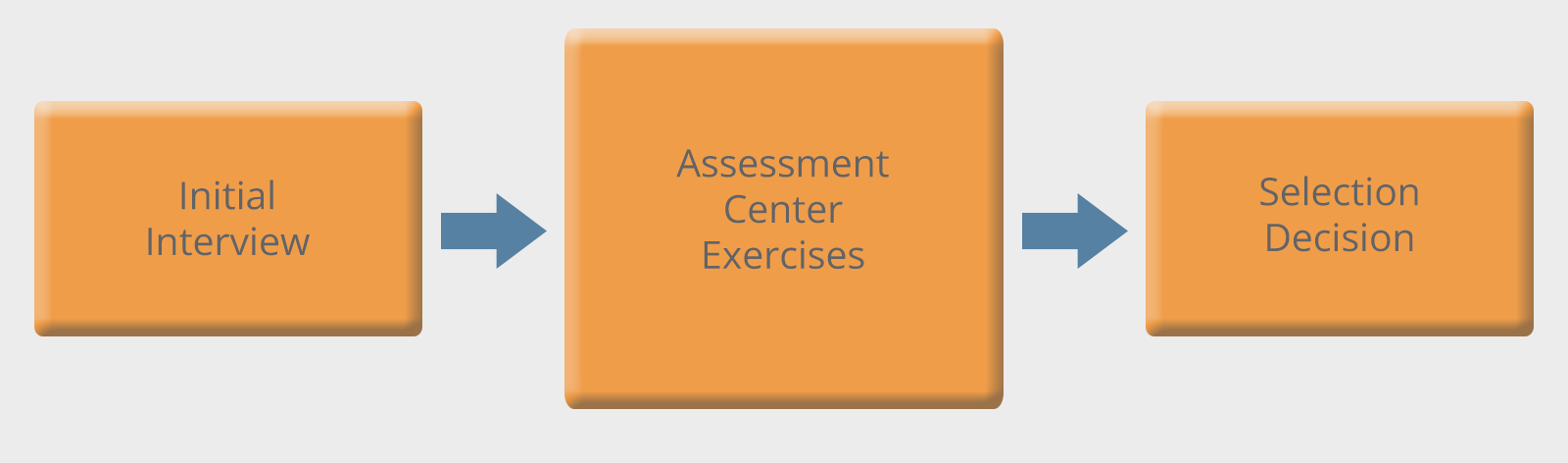
Assessment centres are usually used after the initial stages of the selection process because of the large amount of time and expense in conducting them, and usually follow the initial job interview.
Other measurements such as psychometric tests may complement the selection process.
During each exercise, a group of observers will rate you on a range of set indicators using a prescribed performance scale.
Results are then cross-compared against the same indicators measured in other tests.
Following test completion, observers meet to discuss the test results and reach a group consensus about your ratings.
Assessment centres are highly structured in their design, application and assessment procedure and are specifically adapted to assess factors such as your level of skills, aptitude and compatibility with the organization's culture.
Each test measures a range of indicators within these factors.
At the beginning of the assessment, you should receive an initial briefing about the timetable of tests, location of rooms, etc.
Before each test, you will be given instructions describing the exercise, your role, timeframes, equipment, etc.
You will not be told in detail about the individual indicators which will be measured.
In addition, you are unlikely to receive feedback on your results, unless you have been successfully selected.
Types of Assessment Centre Exercises
Over the many years that assessment centres have been used as part of the recruitment process, a core group of exercises have become recognized as the best ones to assess a candidate’s competencies and behaviors.


The most common type of assessment centre exercises include:
In-Tray Exercises
If you are asked to do an in-tray exercise, you may be asked to assume a particular role as an employee of a fictitious company and work through a pile of correspondence in your in-tray.
The purpose of the in-tray exercise is to see how well you are able to deal with a typical day’s in-tray for the role which you have applied.
Assessors want to see how well your decisions match those of a good manager or executive in their organization.
You will be provided with:
- An overview of an organization and your role within it
- A selection of in-tray items
- A series of multiple-choice questions and an answer sheet
For more senior positions, the in-tray exercise is often followed by a justification section which provides you with an opportunity to explain your chosen answers to the assessors face-to-face.
In most cases, you will be told in your invitation to the assessment centre if your in-tray exercise includes a section to discuss or justify your answers.
The time allocated for the in-tray exercise will vary but it is usually somewhere between 20 and 60 minutes.
You may be given an extra 5 to 10 minutes to read the overview before you receive the in-tray items, or they may all be given together.
Practice Assessment Centre Test with JobTestPrep
In-Tray Competencies:
These tests commonly measure job skills such as:
- The ability to organize and prioritize work
- Time management
- Decision-making without assumptions
- Project management
- Management/team working skills
- Focus on results
- Analytical/evaluation skills
- Communication with team members and customers
- Written communication skills
- Delegation and monitoring of tasks
You will be judged on how well you can handle complex information, determine priorities, make decisions within time limits, display sensitivity to potential problems and communicate clearly.
You will also be assessed on how well you work under pressure and with minimal information.


Justification Sessions:
If you are asked to sit a justification session, you will be assessed on how well you explain your actions and decisions, as well as your resolve to stick with your original decision.
This may be with a small panel of assessors or a small group of the other candidates and an assessor.
The behaviors you would be expected to exhibit in a group justification are similar in terms of how you arrived at your decision, but you will also need to take into account the dynamics of working within a group.
If your prospective role requires you to have considerable analytical and evaluator skills, you may find that the justification is targeted at the most important issues raised in the in-tray documentation.
How to Succeed in In-Tray Exercises:
You do not need to have specialized knowledge of the market sector or industry as all the information required to make a decision is provided in the overview documentation.
Try to imagine that you are at work doing the described duties rather than just completing a test, but make sure that the reasons for your actions are clear and documented – even if this is just a note in the margin.
The most important aspect of the in-tray exercise is to ensure you have fully understood the role you are playing and the objectives of the organization.
Top Tips:
-
Research the organization you wish to join so that you have a clear understanding of their ethos, management style and mission. Ensure that your behaviors and answers reflect these.
-
Only use the information you have been provided. Do not draw your own conclusions and do not be afraid to say you’d want further information before you made a final decision.
-
Although each question will usually pose just one issue, you must consider your answer within the context of the whole picture portrayed in your in-tray items.
-
Most in-tray exercises will have at least 12 items, but for more senior jobs this can increase to 30 or more. It is important not to prematurely discard ones you feel are unnecessary because many short or inconsequential items are put in to create double bookings that you would otherwise miss.
-
It is vital that you pay attention to the small details as the authors of the exercise have often included incorrect or conflicting dates for meetings, old correspondence, misspelled names and missing key information to test this skill.
-
When reading through the items, it is important to highlight or clearly mark the important information each item contains and make notes so that you can explain your decision later.
-
The number of questions in an exercise are designed so that you can answer them all, and it is important that you try to do so, especially if you will be expected to sit a justification at the end.
-
Ensure that you proportion the time you have available sensibly, using several minutes to consider more complex questions and less for simple ones.
The in-tray exercise forms the backbone of any assessment centre and this is because of the diversity of behaviors as well as the knowledge, skills and attitudes (KSAs) that can be tested as part of this exercise.
It is vital that you remember the exercise is designed to show the assessors at your assessment centre how well you perform the key tasks which they have identified as essential for the role.
Presentation Exercise
A presentation exercise can take a few different forms, make sure you know which type of presentation you might be asked to prepare for:
- You might be asked to give a presentation on a fictitious case study that you are provided before the assessment centre. You will usually be given a topic or possibly a choice of topics in advance and will also be told the duration of the presentation, usually around ten minutes with five minutes at the end for questions. You can also expect to receive a list of the presentation equipment that will be available, usually an OHP.

-
If your assessment centre spans two days, the preparation can sometimes be set as an exercise at the end of the first day, or given to you on the day itself. You will be given your topic on the day, along with some relevant data and a set time, typically 30 minutes, to prepare.
-
The presentation can be linked to other exercises, usually the group discussion. In this instance, each candidate is expected to make a presentation detailing the group’s findings or conclusions.
Presentation exercises need to be kept fairly short as the same assessors will usually observe all of the candidates to make sure that the assessment is fair.
At the end of your presentation, the observers will ask a few questions.
Think about the sort of things that might be asked and try to have good answers ready.
If you don’t understand the question, don’t be afraid to ask for clarification and if you don’t know the answer, be honest.
If the assessor disagrees with one of your points, you will be expected to defend your reasoning, but remember to be polite and constructive.
Presentation Competencies:
These tests commonly measure job skills such as:
-
Quality of research – Research the topic carefully. Make sure that your sources are credible and up to date. The internet is the easiest way to research a topic but remember to check any information that you use for accuracy and currency.
-
Organization – Having gathered all of the facts you need to make your presentation, you will need to put them into order. The best way to do this is to make presentation cards, about 3 x 5 inches is ideal. It is best to put the most important facts first and avoid trying to get too much information across in the limited time that you have.
-
Persuasiveness – You need to structure your delivery to ensure that your ideas are well organized, logical and convincing. You can use your cards for this. Write the ‘point’ at the top and summarize the supporting information underneath it.
-
Presentation skills – The only acceptable way to make a presentation is to speak naturally using cue cards to prompt you. You must not simply read a pre-prepared script. To be able to present in this way, you need to rehearse the whole presentation several times. Remember to speak at a steady pace and with clarity so that you can be heard. Keep eye contact with the observers and try not to refer to your cue cards other than when strictly necessary.
-
Time management – The assessors will be checking that you stay within the allocated time frame. There is no excuse for overrunning your time slot or for running out of material when you have been told how long your presentation should take.
-
Career motivation – This aspect of job selection is often overlooked by candidates, but most employers want someone who has a genuine enthusiasm for what they do. Your assessors might be listening to a whole series of presentations on the same or similar topics that day so don’t underestimate how much energy you need to put in if you are going to capture and hold their attention.
-
Organizational and strategic interpretation – Try to demonstrate that you can add value beyond that which the employer expects from the role. This is easier in some presentations than others, it depends on the topic you’re given, but it is often this added value that marks out the successful candidates.
Six Stages of Presentation Giving:
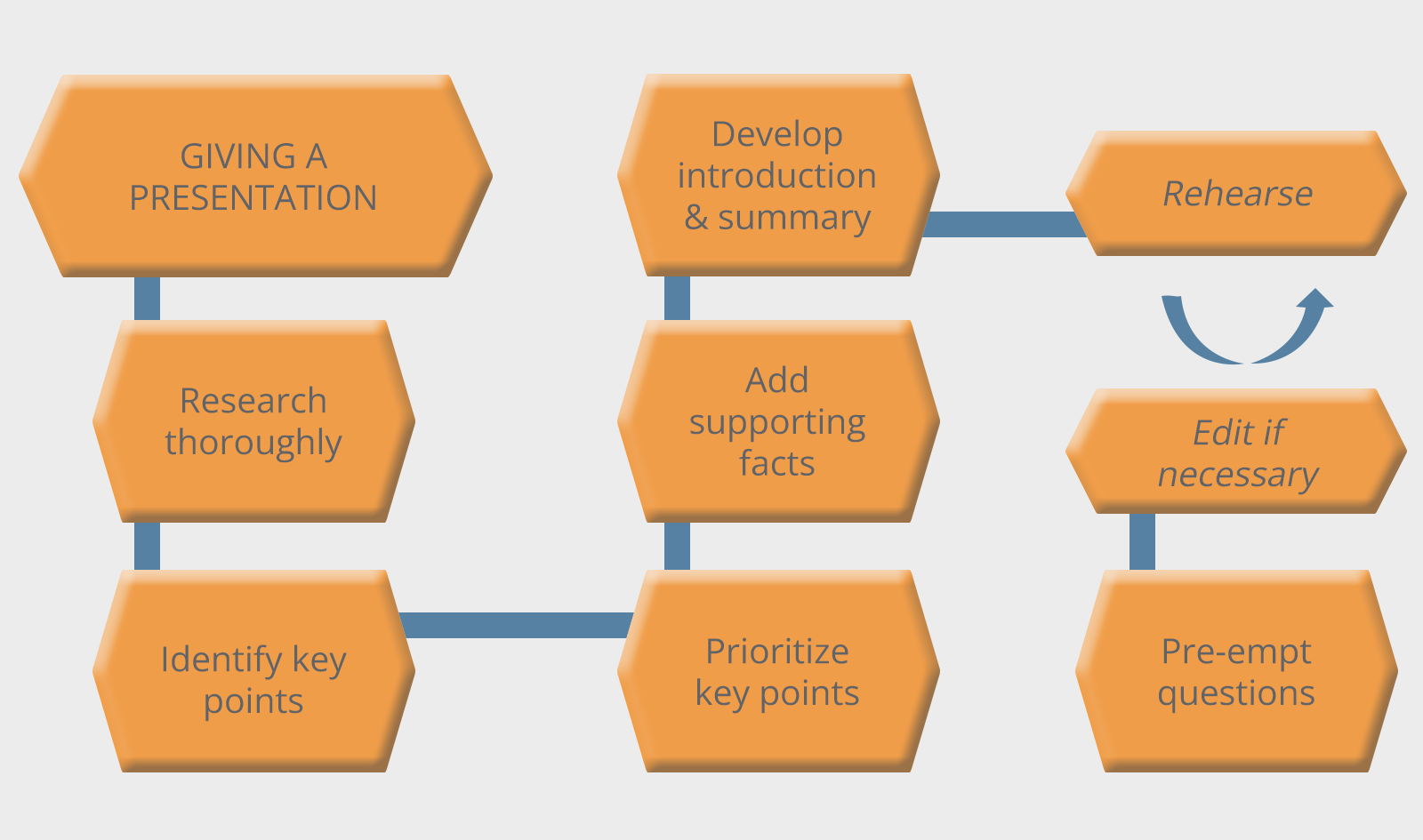
Whichever format a presentation is going to take, you can give yourself a huge advantage by knowing how to prepare properly.
It does not matter whether the preparation time is several weeks or half an hour, if you have a system that you have practiced, you will have far more chance of success than a candidate who just improvises and hopes for the best.
The six-point plan below is both logical and flexible. It is designed to make sure that you don’t waste time thinking about what to do, and that you spend whatever preparation time you have as efficiently as possible:
- Identify the aim
- Identify the key points
- Plan the structure
- Plan the content
- Prepare visual aids
- Prepare for questions
Giving a presentation offers you a much better platform than is normally available when simply answering an interviewer's questions.
You also have far more control in this presentation exercise than in any of the others.
First, you don’t need to consider other participants as you would in a group discussion or role-play exercise.
Second, you have control over how you present your given topic or theme.
So, if you are asked to give a presentation, be prepared to make the most of this opportunity to show what you can do and have to offer.
Prepare for an Assessment Centre
Group Discussion Exercise
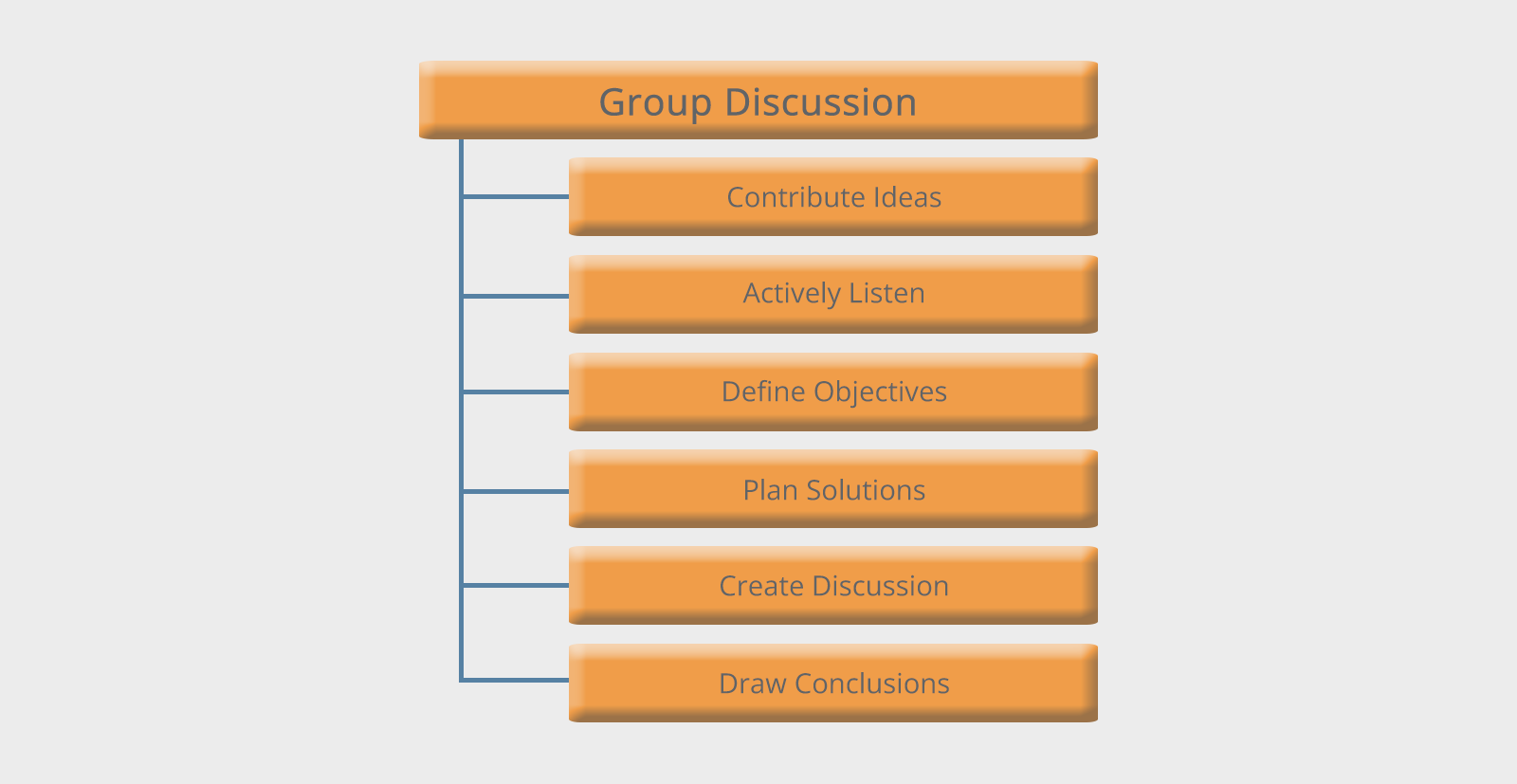
Group exercises involve candidates working together as a team to resolve a presented issue.
This is usually presented in the form of a brief, which also includes a strict time limit when the result of the discussion will need to be conveyed to the assessors.
The majority of group exercises are done with a group size of four to eight people as this will give everyone the opportunity to contribute. It also makes it possible to assign one assessor to each candidate, which makes detailed observation and marking easier.
There are three basic formats that can be used at your assessment centre:
-
Free format – The structure of the group is left entirely to the group itself to work out. You can choose your own role within the group which best displays your strengths. Be careful not to spend too much time competing for certain roles or in over politeness in deciding how to progress. Either of these could result in your group rushing into a decision or not achieving the required goal of the exercise.
-
Partially structured – Each candidate is set a specific task on which they must lead the discussion. The clearer terms of reference make it easier to know when you can contribute to the overall decision or solution. It can be more difficult for you to illustrate your strengths if the role you have been given does not suit you.
-
Structured – A role is assigned to each member of the group. For example, chairperson, secretary, finance controller, personnel, sales, public relations or production. This can be helpful as you will clearly see how you should interact with other candidates.

Group Discussion Competencies:
These tests commonly measure job skills such as:
- Group leadership
- Teamwork
- Social skills
- Negotiation skills
- Group problem-solving skills
- Your ability to take initiative and influence others
- Manners and emotional intelligence
- Independent-mindedness
- Planning, organizing and strategic thinking
You will be assessed on how you interact with others and your impact and influence when working in a team.
Types of Scenario:
The types of scenario used in group exercises varies from physical problems (for example, how to build a bridge over a stream using materials provided), to purely theoretical problems which can be solved by discussion.
The main themes of a group discussion exercise often take one of the following forms:
-
Critical incident – This could be operational (for example, your supplier has just doubled the price of your product’s raw materials) or strategic (for example, there has been a leak to the press on your organizations future direction). The group has to decide how this change impacts the business or organization and present their findings. You will be asked to present or prepare your group’s response and show how you would minimize the impact on the organization.
-
Organizational issue – You will be provided with a full brief on what the organizational issue is and a clear objective you have to meet. Your group may have to address the personnel issues of a re-organization, the financial implications of a merger or the operational impact of an acquisition. The group will have to assess what impact this particular change will have on the organization and put forward suggestions as to how to address this in the best way. The level of position you are applying for will influence whether or not you prepare a presentation or a report.
-
Problem solving and simulation – You will be given a detailed description of the problem you face and, as a group, you will have to agree on a form of action to resolve the problem presented. The type of problem or simulation will have a direct correlation with the role for which you are being assessed. So, technical roles will be faced with problems of a technical nature to solve, management will have a resource issue to address, etc.
If you need to prepare for a number of different employment tests and want to outsmart the competition, choose a Premium Membership from JobTestPrep.
You will get access to three PrepPacks of your choice, from a database that covers all the major test providers and employers and tailored profession packs.

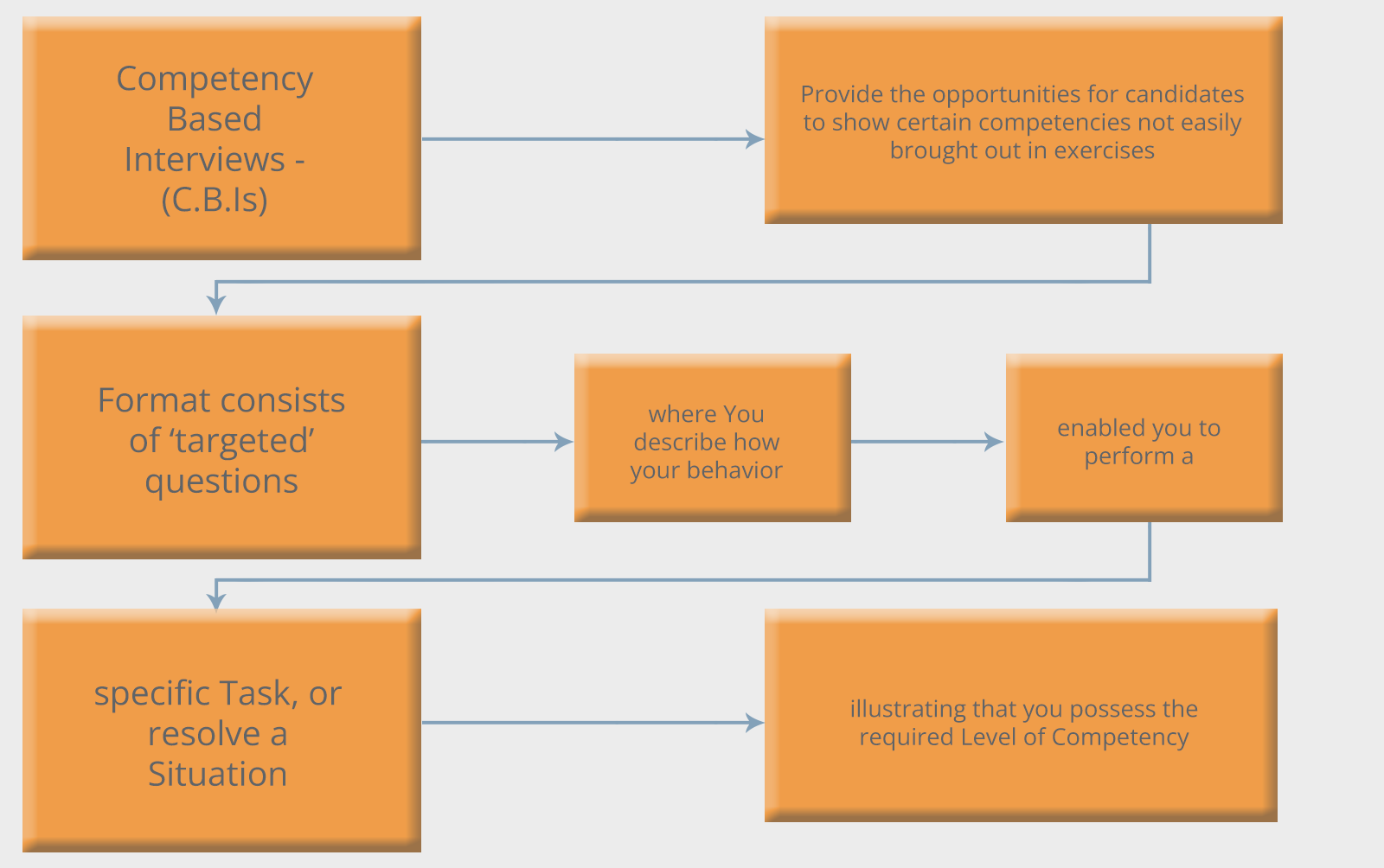
Questions may refer back to your first interview, to assessment centre activities or to aptitude or personality test results.
The assessors will usually ask each candidate the same primary questions; secondary questions will depend on the individual candidate’s responses to the primary questions and will be used to elicit more information about a particular aspect of the competency being tested.
For example,
Interviewer: “Tell us about an occasion where you have shown leadership.”
Candidate: “I was captain of the university basketball team and my responsibilities included organizing the weekly training sessions. This was actually the toughest part of being team captain, once the game actually started everyone was sufficiently self-motivated to give their best performance, but persuading people to turn out to the weekly training sessions was the most difficult part.”
Interviewer: “Go on...”
Candidate: “I found that the best way to motivate players to train was to agree with the coach which particular skill each individual player needed to work on most – we would discuss this after each game. I’d then approach the players individually and ‘sell’ the training session based on that. I found that when players believed that the training session was going to address their own needs, rather than being just general training, they were much more motivated to show up.“
Interviewer: “Interesting, can you give me an example of how you would ‘sell’ a training session? What type of thing would you say to a player?”
If you need to prepare for a number of different employment tests and want to outsmart the competition, choose a Premium Membership from JobTestPrep.
You will get access to three PrepPacks of your choice, from a database that covers all the major test providers and employers and tailored profession packs.
How to Succeed in a Competency-Based Interview:
It is important to first identify what competencies will be assessed.
Some employers will provide this information before interview and some will not. If possible, you should ask, as this will save you a lot of guesswork.
If this information is not provided explicitly, you will need to work out the likely competencies required from the job description and the information that you have about the organization.
There are three approaches that you can take to answering competency-based interview questions:
-
No preparation, just answer spontaneously – Unfortunately, this approach does not work very well with CBIs. This is because you are expected to reply to questions with specific examples and, because you are under a lot of time pressure, you won’t always have time to pick the best one. This can undermine your confidence as well as failing to illustrate convincingly the competency in question.
-
Try to prepare a model answer for every possible question – Even if it were possible to memorize ‘ideal’ answers, there are two problems with this approach. First, memorized answers don’t sound sincere. Second, they won’t usually be consistent with the information on your CV or resume.
-
Use the STAR method (Situation, Task, Action, Result) – This method will provide you with answers which illustrate convincingly the competency in question as well as being consistent with your CV/resume.
Role-Play Exercise
For the role-play exercise, you will usually be asked to assume a fictitious role and handle a particular work situation.
The key purpose of the exercise is to again see what competencies you display and how your behavior matches those of the required role.
Role-plays usually use specifically trained individuals, consultants or professional actors who are clearly briefed about their role and how to respond when you take a particular approach.

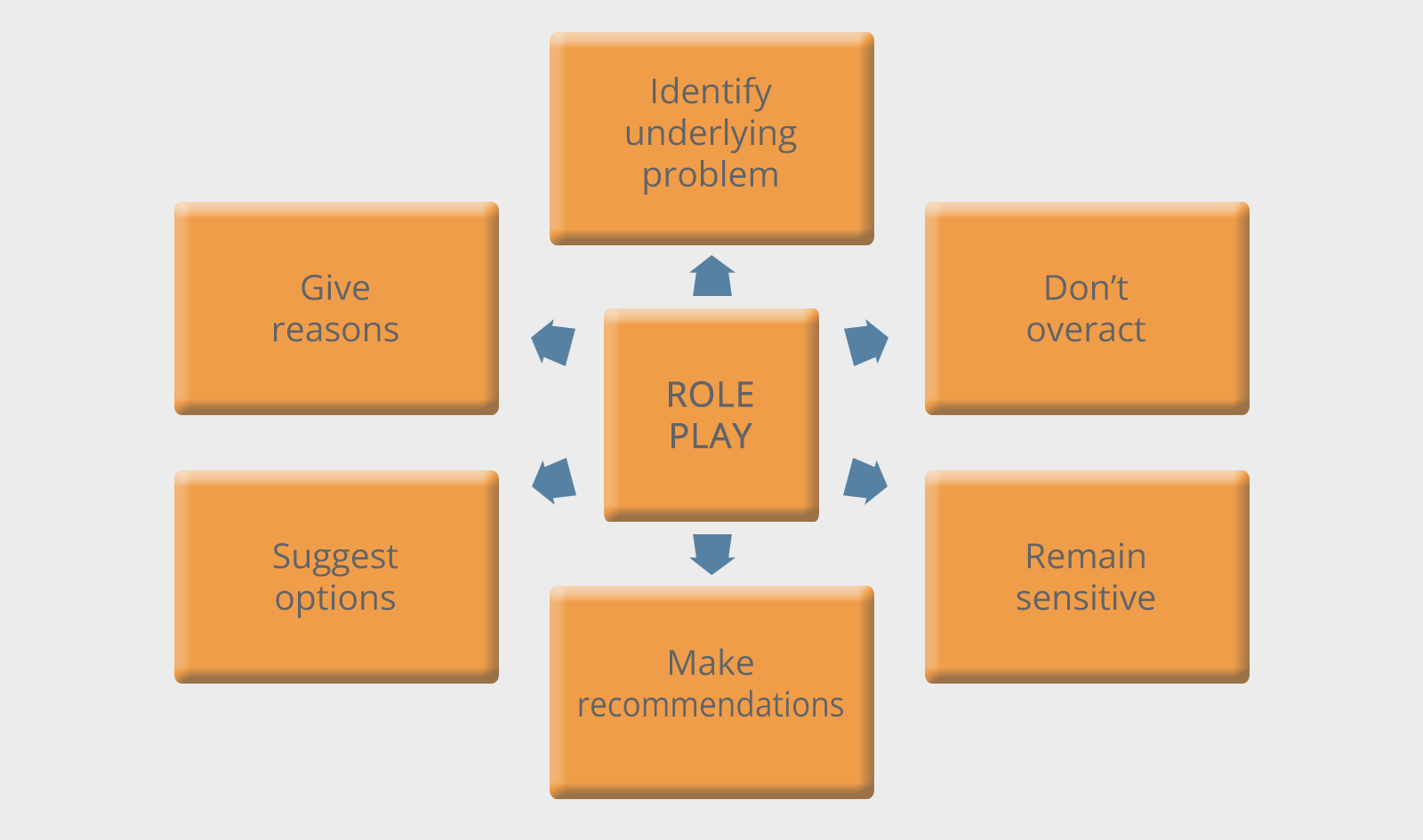
You may need to make a conscious effort to overcome your natural responses in these exercises.
For example, the assessors are looking to see whether you can exhibit sensitivity or toughness in those situations that require it, not whether you are a naturally sensitive or tough person.
This type of exercise also allows the assessors to actually test how you respond when put on the spot or when dealing with conflict.
Role-Play Scenarios:
The scenarios will be based on the sort of situations that are very difficult to emulate in any other sort of test or interview.
They usually take a one-to-one format with an assessor observing the interactions.
For example:
- Handling a difficult customer or complaint
- Disciplining or appraising a member of staff
- Negotiating a contract or project delivery
- Meeting to discuss your company’s equality record
- Discussing an aspect of your company merger
If you are likely, as part of your role, to be involved with talking to journalists or fielding press inquiries, then you might face a media interview exercise.
You can view this as a unique role-play exercise designed to assess how well you perform with the press.
When you look at the likely scenarios that will come up in this type of exercise, you will appreciate that a wide variety of job positions could find themselves in the situation where they are required to speak to the press or a journalist.
The most probable scenarios are:
- Following a merger or acquisition
- Staff redundancies
- Office/plant closures
- Poor financial results
- Environmental issues
You can quickly see that all of these scenarios have a negative aspect, which the majority of journalists will exploit.
This exercise is designed to test how you respond to a crisis or unexpected situation.
Role-Play Competencies:
The most popular behaviors assessors are looking for in this exercise are listed below.
You must review this list in the context of the actual role and organization you are applying for so that you can add or amend this list accordingly.
The key behaviors you need to show are:
- Excellent verbal communication
- Planning and adaptability
- Decision making
- Evaluation and analysis
- Mentoring and coaching
- Change agent
- Customer focussed
How to Succeed in a Role-Play Exercise:
-
Discern from the advertisement, job specification and your knowledge of the organization the key competencies the role requires. With this knowledge, you can ascertain which behaviors you will be required to show and which ones are most likely to be part of the role-play exercise.
-
Research the organization’s ethos thoroughly to give you a clear understanding of its mission and how to communicate this to others. The more familiar you become with the organization's ethos and values, the more easily you will be able to communicate as if you were already part of the organization.
-
In addition to these preparations focused on the organization and its activities, you should also source a host of supporting industry facts and figures to help you talk about industry issues more generally.
Social Event
If you are invited to an assessment centre, it will probably involve at least a buffet lunch or, in some cases, an evening dinner.
This is the part of the recruitment process that is not formally assessed and is meant to be an informal way for you to find out more about the organization and its values.
However, these social events do provide the assessors with an opportunity to see how you engage with your peers and what questions you ask incumbent managers and recent graduates.
They also provide an opportunity for the assessors to see how you act in an informal social environment.

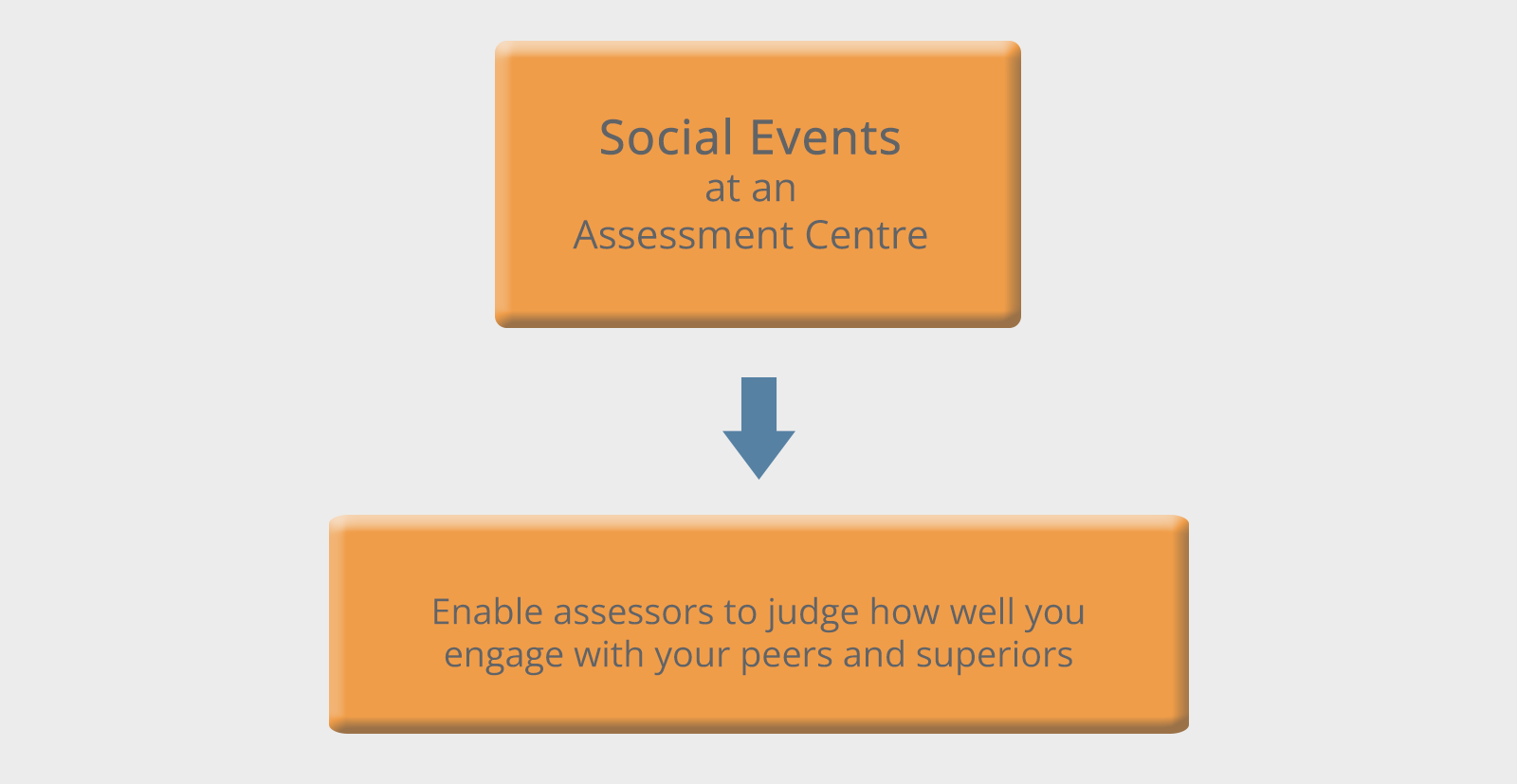
The assessors need to be confident that you are going to be a good ambassador for the organization, particularly if your role is likely to involve socializing with clients or people from other organizations.
The ability to engage in polite conversation with strangers and to behave socially within the conventional norms is essential.
How to Succeed at the Social Event:
If you are being selected for a management or graduate-level position then it is a good idea to brush up on your knowledge of current affairs and global news. This will enable you to discuss any topical issues that crop up over lunch or coffee.
In addition to being up-to-speed on the latest industry and world news, being good at small talk is an impressive asset.
It creates the impression that you are a relaxed and confident person and that you would be a good representative for the organization, especially if your future role involves client contact.
If there is a coffee break or buffet then your main aim is to chat with as many people as possible to show off your social skills.
-
If you are being introduced to someone, first look at the introducer and then at the person you are meeting and, if offered, shake hands. Listen carefully to their name and repeat it in conversation as soon as possible to help you remember it.
-
If someone approaches you, you should give them your full attention. Listen for any information that you can use to formulate a question and get the conversation going.
-
If you wish to approach someone or a group of people, do it from the front so that they can see you coming. Say the other person’s name, if you know it. If not, smile, put out your hand and say “Hello I’m...” and then add some information that will identify you and/or outline the reasons for presenting yourself.
-
If you want to move on to another individual or group then you need to do this politely and take into account that the people you are with should be acknowledged before you move on. It is a good idea to indicate your empty coffee cup or glass and say ‘I think I’ll go for a refill, it was nice speaking to you’ or something similar.
-
If others have joined your conversation and it is not possible to move on without interrupting things it is still important to make eye contact and leave with a smile or a wave.
What Competencies and Behaviours Are the Assessors Looking For?
We need to consider what exactly is meant by the term ‘behaviors’ and how this can be related to the competencies required for the role.
To do this, we need to introduce the concept of KSAs.
This term was defined in the definitions table as the knowledge, skills, abilities and attitudes that are required for competency.
Competencies are general descriptions of the behavior and underlying characteristics needed to successfully perform a particular role at the required level.
They are concerned with how an individual carries out a particular element of their role rather than merely what they do.
As you can imagine, competencies and behaviors are quite difficult things to specify and to measure accurately.
The professionals who design assessment centre exercises usually try to overcome this problem by subdividing behaviors into separate factors that are more specific and therefore easier to measure.
In each of the exercises, the assessors want to see you exhibit the behaviors that are seen as essential for the job and they will be assessing your behaviors using the following criteria:
-
Knowledge – Do you have the knowledge necessary for the role? This will encompass technical, procedural and organizational knowledge as well as knowledge of the market, your competitors, etc.
-
Skill – Can you exhibit the necessary skills at the appropriate level during the assessment day? Skills include things like written and verbal communication, negotiating ability, analytical ability, judgment, etc.
-
Attitude – Do you show the appropriate attitude to the situation or scenario being played out in the assessment centre exercise. This affects how you interact with others and how you are perceived by them.
Whenever you are considering your approach to a particular exercise, you should think in terms of demonstrating the appropriate KSAs.
Using the exercises as vehicles to demonstrate your KSAs will ensure that you tick more boxes on the assessor’s forms.
How Do I Demonstrate My KSAs in an Assessment Centre Exercise?
You cannot predict exactly how much information you will be given in each assessment centre exercise or whether it will be based on a real-life scenario or a fictitious one.
Neither can you be sure that you will always be given sufficient information to be certain of making the correct decision.
Many candidates are put off by this unpredictability and perceived lack of realism in the exercises and perform badly as a result.
These issues can be dealt with by asking yourself the following questions as you work through each assessment centre exercise.
- What knowledge does this enable me to demonstrate to the assessors?
- What skill does this enable me to demonstrate to the assessors?
- What attitude does this enable me to demonstrate to the assessors?
To illustrate how you can demonstrate your KSAs, we have listed some examples below.
You must formally demonstrate your KSAs, either by making notes or, in the case of item 3, by what you actually say.
Prepare for an Assessment Centre
In-Tray Exercise Scenario
This in-tray exercise puts you in the position of a marketing manager for a fictitious company that produces solar panels for domestic hot water and heating systems.
You are expected to work through a number of items in your in-tray and deal with them appropriately.
In-tray item 1:
The first item is an email from an automotive racing team who are asking if your company would like to explore a sponsorship deal.
-
Knowledge – Does the company already have a sponsorship deal, if so, is it exclusive? If not, would it fit in with other sponsors, the company mission statement and the overall ethos of the company?
-
Skill – Use your judgment to decide if the company’s positioning in the marketplace is consistent with this type of sponsorship. For example, if the main thrust of the marketing efforts were based on green and environmentally friendly messages then it would not be appropriate. However, if the marketing messages stress the ‘high-tech’ nature of the products then it might be a good fit.
-
Attitude – Even if the request for sponsorship was entirely inappropriate and you are under a lot of time pressure in this exercise, your response should still be polite and businesslike. You are the public face of the company.
In-tray item 2:
This is an email from a journalist with GreenLife magazine.
It has an article attached and the journalist is asking if you have any comments before publication.
The magazine describes itself as being aimed at ‘environmentally aware people who are building or improving their homes’.
Scanning the article, you can see that it is generally positive about your products, particularly the technical capabilities, but there are some negative comments about the fact that the products are made in Indonesia.
Specifically, the article is critical of the conditions in the factory and the amount of energy consumed in the manufacture and transport of the products.
-
Knowledge – Are the readers of this magazine part of the target market for the products? Is the magazine influential? This will influence how much priority you give this item. Does the organization have a full-time press officer? Is he or she likely to have a working relationship with the journalist? Has the company had an environmental audit?
-
Skill – You can display judgment by prioritizing this item as well as outlining and ranking the options available to you.
-
Attitude – Your attitude will be apparent from how you deal with this item. Did you approach it in an analytical way and are your decision options the result of clear thinking?
In-tray item 3:
You will also receive a telephone call from an actor who is playing the part of a subordinate. He is at a trade exhibition representing the company. He is upset and concerned because a member of the public has tripped over on the exhibition stand and broken their wrist.
-
Knowledge – There is not really any opportunity to demonstrate your knowledge with this item. It is exclusively an opportunity to display your skill and attitude.
-
Skill – You can display your communication skills by dealing with your subordinate in such a way as to calm him down and outline an action plan for dealing with the incident.
-
Attitude – The challenge is to deal sympathetically but efficiently with a subordinate who is obviously upset whilst you yourself are under time pressure.
As you can see, even simple items like these three examples give you ample opportunity to demonstrate your KSAs.
Who Are Your Assessors?
Tina Lewis Rowe provides an excellent definition of an assessor:
An assessor is an individual trained to observe, record, classify and make reliable judgments about the behaviors of those being assessed.
Source: Lewis Rowe, Tina; A Preparation Guide for the Assessment Center Method; (2006) Charles C Thomas Publishers Ltd, Illinois, USA.
They are usually people one level above the position you have applied for.
They will be ambitious and successful individuals within their own departments.
These people will have a very clear idea of the qualities they expect to see in an individual performing the new role.
Many agencies have a preferred list of assessors they like to use and the human resources department will have key people they call upon for the assessment centre days.
For senior roles, assessors who are external to the organization may be used to bring a broader perspective to the assessment.
The training an assessor receives, whether they are internal or external to the organization, will equip them with the skills to observe, classify and record candidates’ behavior during the exercises.
They will also have a thorough understanding of the requirements of the role and will have studied the job specification.
From this knowledge, a list of key behavioral areas will be drawn up, each having a more detailed description to ensure consistency among the assessors when scoring candidates.
There are three things you need to remember about the assessors:
- They know nothing about you
- They can only give you marks for behaviors you show them during the exercises
- They are only concerned with how well you display the behaviors applicable to the role
Your key objective is to find out what behaviors the assessors see as essential, desirable, adequate and a liability.
For many organizations, their human resources department will have drawn up their own specific scoring sheet which they will modify as appropriate for the role in question.
This scoring is usually from 1 to 10; 1 being poor or unsatisfactory and 10 being totally capable and suited to the role.
The assessors will follow each exercise with a discussion.
This discussion will give them all an opportunity to say what they observed and how they've marked this behavior and then to gain a consensus from the group to award the candidate a final score for an exercise.
This ensures that each candidate is judged fairly and that the company or organization has a thorough record of how a final decision was made.
Many organizations like to include an exercise where they use multiple assessors, usually a minimum of three people, and they will be at least one level above the position you are applying for.
In these exercises, the panel will be made up of diverse individuals, some may be external to the organization or department.
So you will need to be mindful of assessors who may have different priorities and adapt your behaviors accordingly.
How to Prepare for an Assessment Centre in 2026
If you are a graduate, your most influential factor to success will be your preparation for the assessment centre and how you ensure that your behavior and language matches that of the organization.
As your career develops you will acquire competencies that you did not possess as a graduate so you will be able to differentiate yourself from the other candidates because of these experiences. As part of your preparation, you will be able to bring out how these additional competencies increase your compatibility with those of the role and organization.
Here are our top tips for success in an assessment centre:
Step 1. Know the Competencies Required for the Job
Always remember that the assessment centre exercises are designed to judge how well you exhibit the required behaviors of the job you are applying for.
Step 2. Research the Organisation and Sector
Make sure you have good background knowledge of the sector, the organization and its products and services.
Step 3. Keep Up Your Knowledge of Current Affairs
If you are being selected for a management or graduate level position then it is a good idea to brush up on your knowledge of current affairs and global news.
The international publication ‘The Economist’ is probably the most useful publication to study for this purpose.
You should also read the most recent copies of any relevant industry-specific magazine or newspaper. This will enable you to discuss any topical issues that crop up in the panel interview or over lunch or coffee.
Step 4. Be a Team Player
When working in a group, remember that the observers are usually looking for candidates who show evidence of being team players and fully commit to the tasks they are set.
Be adaptable in your thinking and recognize other candidates' good ideas but remember that talking people round to your point of view will demonstrate good communication skills provided that it is done in a positive and inclusive way.
Step 5. Don’t Take Over
You can't afford to appear too introverted but you must avoid interrupting others or taking over the discussion.
Don't try to outmaneuver other candidates or dismiss opposing points of view in a negative or aggressive way.
Step 6. Participate Fully and Encourage Others
Try to express your views clearly and concisely and make an effort to encourage participation from quieter candidates where applicable.
Prepare for an Assessment Centre
Assessment centers are a recruitment process used by many large companies.
They allow recruiters to assess your skills and personality in real-life situations such as:
- How you present yourself
- How you introduce yourself
- How you interact with others
Assessment centers typically last one day and always include a group interview and a project or presentation. You may have to complete aptitude tests, additional activities, role-plays and an individual interview, depending on the role.
They are commonly used for graduate programs, when moving to a managerial role or when a company is mass-hiring.
When introducing yourself in an assessment center, you want to be confident but not obnoxious.
With a firm handshake (if appropriate), state your name, your current position and the position you are applying for. If it is a graduate role, state your school and major.
In some cases, the assessor might ask you to mention something specific as an icebreaker, such as a hobby or favorite movie.
In this instance, try to think of something that will help you stand out from your peers.
If they want to know what you do in your spare time or as a hobby, choose something that also demonstrates the skills needed for the role you are applying for.
Assessment centers are designed to be challenging, but it is possible to pass with the right preparation.
Before the assessment center, ensure you have:
- Researched the company, including its values and mission statement
- Researched assessment center activities and how to pass each one
- Searched and read online forums discussing past assessment centers
- Prepared your clothes and elevator pitch
On the day of the assessment, remember to be confident and engaging. Show the assessors that you are someone they want to work with and that you have the appropriate skillsets.
In most circumstances, it is not okay to reschedule an assessment center. The recruiters will assume you are not serious about the role or are unreliable.
However, if there is an emergency, contact your recruiter ASAP. Explain that you are serious about the role, but this emergency takes priority, and what is the earliest you can reschedule.
It might be that you will have to wait until the next recruitment drive.
Following an assessment center, you should send a thank you email to your recruiter and any follow-up emails to the people you met.
This will remind them of who you are and help you stand out from the other candidates.
Depending on the company, you will be called in for a final interview or offered the position.
Towards the end of the assessment day, the recruiters will inform you of the next stages and approximate timelines.
It is also common for companies to only communicate with successful candidates, so ensure you do have that timeline. This way, if you are unsuccessful, you know when to start applying for other roles.
The best way to prepare for an assessment center is to do as much research as you can.
Research the company values and culture, company updates, industry news and trends, assessment center procedures, and past assessment centers.
The best ways to stand out at an assessment center are to be prepared, act professionally, be honest, be respectful, listen just as much as you speak, remember that you are being assessed from the moment you step in the room and look the part.
Assessment centers involve various activities designed to assess your skills in real-time. The activities include group interviews, role plays, presentations, case studies and projects.
You can expect to be asked common interview questions such as “Why do you want to work for this company?", “What is your ideal working environment?” and “What is your biggest weakness?”.
Depending on the role you are applying for, you may be asked to demonstrate technical knowledge or leadership style.
There are four different types of assessment centers:
- Elite Graduate – Typically used by Fortune 100 companies and government agencies.
- Graduate – Used across all industries and companies with yearly graduate schemes or programs.
- Management – Designed to find the best leaders, the candidates at these assessment centers vary in age, background, experience, and education.
- Developmental – Typically for candidates moving from junior or less specialized roles to more senior or specialized positions.
The purpose of an assessment center is to find the best candidate or candidates for the role a company is recruiting for.
All the activities allow assessors to see your skills and personality in action. They can see how you carry yourself and how you interact with others.
As well as testing your skills, this information allows the assessors to assess how well you fit in with the company culture.
While some people struggle with confidence in assessment centers, they are an effective tool in the recruitment process.
Assessors can assess your skills and behavior over a longer period with different activities.
All the information they gather during the assessment center gives them a clearer idea of who you are as an employee.
Each company will have specific requirements and activities at its assessment centers. However, as a guideline, you can expect there to be:
- A presentation from the recruiters
- Different assessments such as role-plays, presentations, and group interviews
- A chance to meet other employees
Your recruiter will most likely place you in pre-assigned groups for the assessments and ask you to follow a schedule.
Again, depending on the structure, your day might be full-on and compact, or you may have time to chat with the other candidates.
Both are equally important. However, an assessment center allows the recruiter to gather more information and hire the best possible candidate.
For the candidate, an assessment center gives you the chance to show exactly what you have to offer. You can show more of your personality and demonstrate more skills in a less forced environment.
Interviews are often very formal and structured, with little room to show your personality.
The assessment center assessments require you to work with others, demonstrate multiple skill sets, and show creativity.
Some candidates prefer being in large groups as it is less intimidating and informal.
Summary
An assessment centre is an important and often nerve-wracking part of the recruitment process. It is important that you feel fully prepared so that you can perform your best on the day.
We recommend using JobTestPrep's practice packages to help you pass.